Before choosing your first credit card, answer two questions: how much cash would I need to open this account, and how much would I owe after using it? Those numbers aren’t interchangeable. A refundable deposit may tie up money today; it doesn’t pay next month’s bill.
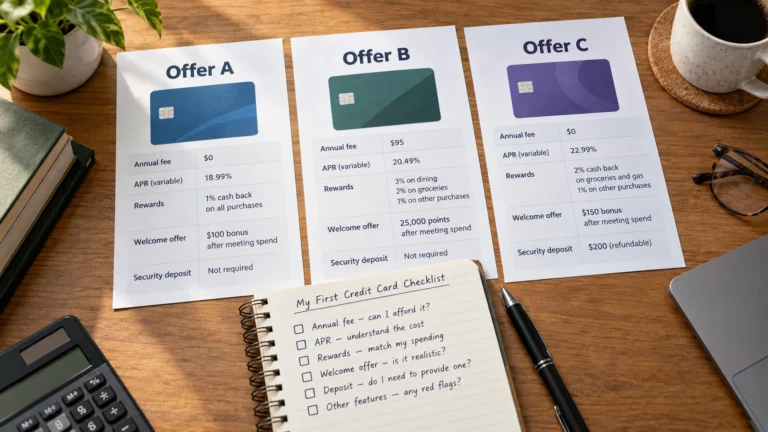
Three numbers to write down
Due at opening. Check for a required deposit or opening fee. A $200 refundable deposit and a $200 nonrefundable fee both affect this month’s budget, but only one can come back to you. Check the issuer’s refund conditions.
Cost to keep the card. Look up the annual fee after any introductory waiver. At $300 in eligible purchases a month, an extra 1% cash back earns $36 a year. It wouldn’t cover a $60 annual fee by itself.
Amount to pay on the due date. The minimum payment and the statement balance serve different purposes. If a purchase grace period applies and you aren’t carrying a balance, paying the full statement balance by the due date generally avoids interest on those purchases. The CFPB explains how the grace period works.
Which kind of first card fits the cash you have today?
Suppose you have $350 in checking after rent. One issuer offers a secured card with no annual fee and a $200 refundable deposit. Another offers an unsecured card with a $39 annual fee. Assume you qualify for either and both report your payments. Which is cheaper? Over two years the unsecured card costs $78 in fees; the deposit is not a $200 fee. But if you need $210 for groceries before payday, tying up $200 leaves only $150. The cheaper card on paper may be the wrong card this week.
A third answer is to wait, or look for a no-fee, no-deposit option at your bank or credit union. There is no prize for opening an account before you can use it comfortably. A secured card is useful when the deposit fits your cash flow and you understand how to get it back. Ask the issuer whether it reviews the account for an upgrade, whether closing with a zero balance releases the deposit, and which credit bureaus receive your payment history. Don’t assume a refund after a particular number of months. The CFPB’s guide to starting a credit history also explains why a prepaid card isn’t a substitute for a secured credit account.
Read a first statement: four numbers, two different decisions
Imagine you have a new card, no prior debt, a purchase grace period and no fees. Your May statement closes with $180 in purchases. On June 2 you buy another $45 of groceries. When you open the app, the balance says $225. The statement says $180, the minimum is $25 and the due date is June 18. Those figures can all be correct at once.
| What you see | What to do with it |
|---|---|
| Statement balance: $180 | With the assumptions above, pay this amount by June 18 to avoid interest on the billed purchases. |
| Current balance: $225 | Includes $45 from the new billing cycle. Set the money aside; it wasn’t on the May statement. |
| Minimum payment: $25 | Paying only this amount on time meets the example’s minimum but leaves $155 of the statement unpaid. |
| Payment due date: June 18 | Check when your issuer must receive the payment. A reminder to pay is not a completed payment. |
If you already carried a balance, took a cash advance or used a promotional financing plan, don’t apply this simple example to every part of your bill. Find the interest-charge section of your statement and check the terms for each balance. Ask your issuer what you must pay and when to regain the purchase grace period if you’ve lost it. That is a different question from asking for the minimum due.
Set up your first month before you make the first purchase
Pick one expense you already pay, such as a $30 phone bill. When it posts, set aside $30 in checking or mark it as spent in your budget. Charging it to the card changed the payment date; it didn’t make an extra $30 available. If you are paid irregularly, try this with one small purchase rather than moving all your bills to a new card at once.
Set a statement alert and a second reminder a few days before the due date. If you enable automatic payments, read which option you selected: minimum, fixed amount or full statement balance. Verify the linked account and the date the first automatic payment takes effect. Open the first statement anyway. A $100 fixed payment looks generous until the bill is $140; the missing $40 changes the result. Conversely, a full-balance debit can cause problems if rent clears the bank the same morning. Compare the calendar with the cash that’s actually there.
After the first payment, check two things: that it posted to the card account and that the bank account covered it. Save the first statement somewhere you can find it. You’ve now tested the real process from purchase to repayment. That tells you more about whether this card suits your life than an advertised rewards rate does.
Building credit doesn’t require paying interest
A $500 credit limit answers “how much will the issuer let me borrow?” It doesn’t answer “how much can I afford?” Suppose $90 remains after you’ve set aside rent, food and transport. A $150 purchase fits the limit but not your budget. The extra $60 has to come from somewhere. Don’t use the number on the card screen as your spending plan.
You also don’t need to leave a few dollars unpaid to prove you can borrow. The CFPB’s credit-score guidance emphasizes paying on time, keeping balances low relative to your limits, and checking your credit reports for errors. It does not require carrying debt from one bill to the next. Treat a promise of a specific score increase by a specific date as just that: a promise, not something your first card can guarantee.
What if your first bill doesn’t look right?
First separate a charge you recognize under an unfamiliar business name from a purchase you never authorized. Compare the posted amount with your receipt and ask anyone authorized to use the account. If you suspect unauthorized use, contact the issuer promptly using the number on the card or in its official app. Don’t call a number from an unsolicited text claiming it can “reverse” a charge.
For a billing error on a U.S. consumer card, a phone call and the formal dispute process aren’t necessarily the same thing. The CFPB’s billing-error instructions explain the written notice, the 60-day window and where to send it; the billing-inquiries address can differ from the payment address. Keep a copy and continue paying amounts you do not dispute on time. If the amount is correct but you can’t afford the minimum, that’s not a billing dispute. Call the issuer promptly and explain what you can pay and when, rather than waiting for the account to fall further behind.
Before you submit an application
Answer these questions in your own words: How much cash would opening tie up? What fee would I pay to keep it next year? Which purchase will I test first? Which paycheck covers the bill? What would make me walk away? “I need the deposit for rent” and “the issuer won’t clearly explain the fees” are both complete answers. Looking at three offers does not mean submitting three applications: applications can result in hard credit inquiries.
For a side-by-side decision rather than a list of definitions, use our three-offer first-card comparison. It puts the same monthly budget through three fictional offers and shows exactly where the result changes. If your next question is what happens after approval, keep the statement example above for the day your own first bill arrives.
Try it with offers you already have
Open the rates and fees for two or three cards. On the one-page comparison worksheet (PDF), record the fee, deposit and purchase APR before filling in rewards. Mark anything you can’t find as “unknown,” not zero. There is no need to apply just to do the comparison.
Already have a card and pay in full? Compare an ordinary month of spending instead.