A card that earns 3% at restaurants looks better than one that earns 1% everywhere. But what if you spend only $100 a month eating out and the first card costs $95 a year? The extra dining rewards are just $24 a year. Before you apply for your first U.S. credit card, take one ordinary month of spending and make each offer earn its place.
Start with three questions: What will I pay just to have this card? What happens in a month when I can’t pay in full? What will I actually get back on purchases I’d make anyway? Below, three fictional offers show how the answer changes. You can use the same test on offers from a bank or credit union without submitting an application.
Print it or use it as a guide in your notes. No email, credit score or bank login needed. Already have offers open? Jump to the example or skip to the final checklist.
1. Read the price tag before the rewards pitch
On each issuer’s application page, find the link marked Rates and Fees, Pricing and Terms or something similar. Keep it open next to the rewards terms. One tells you what borrowing and owning the card can cost; the other tells you which purchases earn what. A promotional headline is not a substitute for either. The Consumer Financial Protection Bureau’s credit card glossary explains the terms you’re likely to see.
Annual fee: This is the price of keeping the card for a year, even if it sits in a drawer. Write down two figures: the fee in the first year and the fee at renewal. A waived first-year fee answers only half the question. Also look for a monthly maintenance or account-opening fee. A card advertising a $0 annual fee isn’t necessarily free to own.
Security deposit: A deposit ties up cash; it isn’t the same as a nonrefundable fee. A secured card may require $200 upfront and still send you a bill for every purchase. Buying $40 of gas doesn’t subtract $40 from that deposit as it would on a prepaid card. You still owe the $40. Ask when the deposit can be returned, what happens if you close with a balance and whether you can spare the money in the meantime. The CFPB explains secured versus prepaid cards.
Fees that match your life: Going abroad? Write down the foreign transaction fee. At a hypothetical 3%, $600 of qualifying foreign purchases costs $18 in fees. Never expect to use the card abroad? That line matters less than a fee you’ll pay every year. Leave an unknown term marked “unknown.” A blank is not the same as $0.
2. Test the month when you can’t pay in full
The purchase APR is the annualized interest rate for ordinary purchases. It isn’t a charge on every purchase you make. With a purchase grace period, you can generally avoid purchase interest by paying the full statement balance by the due date when you’re not already carrying a balance. Paying only the minimum isn’t the same thing. Cash advances usually have different rules and generally begin accruing interest immediately. Read the CFPB’s explanation of grace periods.
Imagine a statement showing $240 due, with a $30 minimum. You made another $40 purchase after the statement closed, so the account now shows $280. With the purchase grace period still in effect and no other balances, it’s the $240 statement balance that matters for avoiding interest on those billed purchases. Paying $30 on time meets the stated minimum, but it leaves $210 of that statement unpaid. Don’t confuse the minimum with the interest-free payment.
Now suppose $500 accrues interest for 30 days at a purchase APR of 20.49%. A simple estimate is $500 × 0.2049 × 30 ÷ 365, or about $8.42. That’s more than the $5 earned on $500 of purchases at 1% cash back. Your actual charge depends on the issuer’s method, dates and changing daily balance. If this resembles an ordinary month, compare borrowing costs before rewards. For a promotional APR, write down when it ends and which transactions qualify. How credit card interest is calculated.
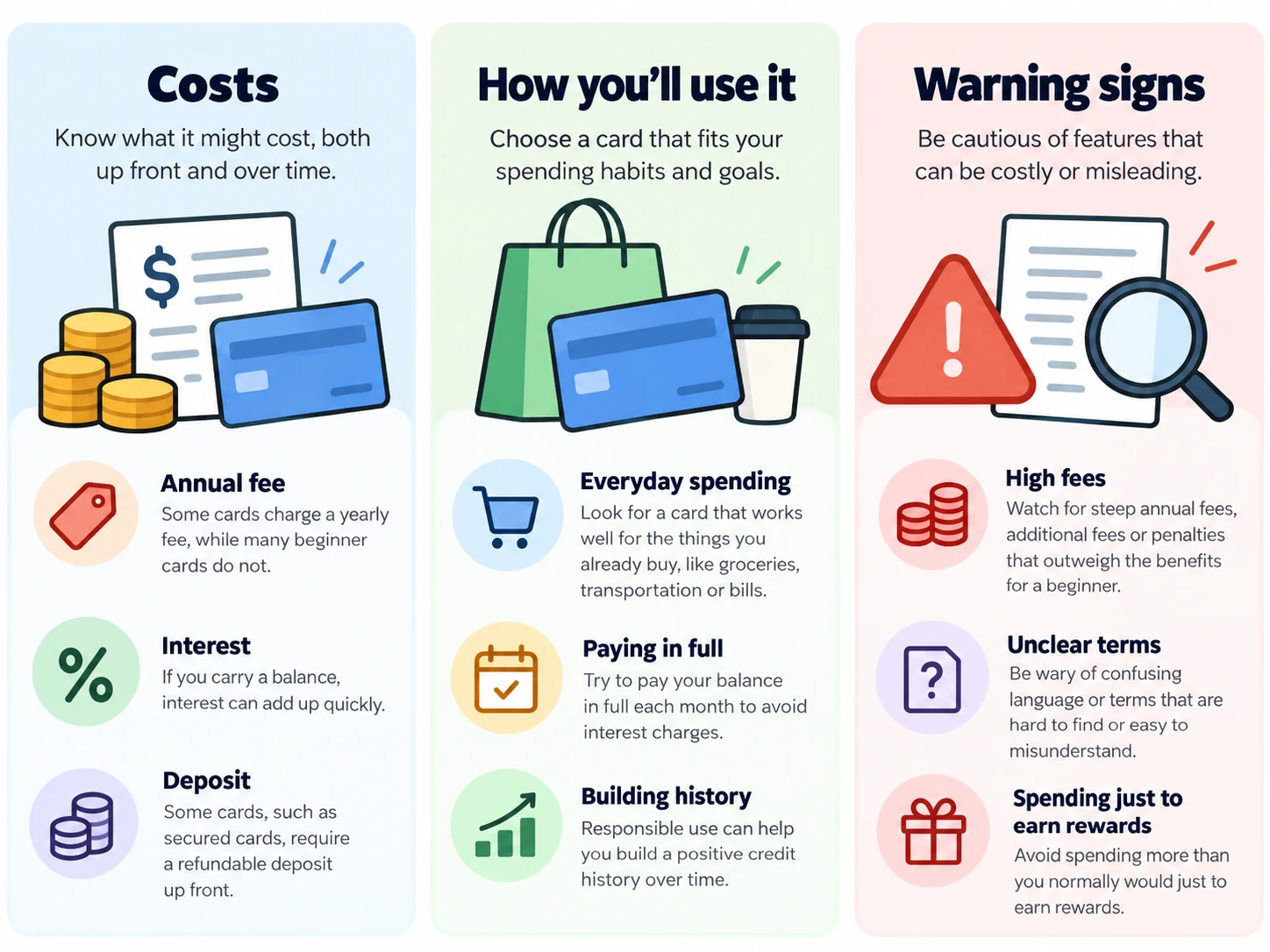
3. Put three offers through the same $600 month
Here are the three fictional U.S. offers in the illustration. They are teaching examples, not cards you can apply for, market averages or promises of approval. To isolate the ongoing value, assume the purchases qualify for the categories shown, spending is identical for 12 months, rewards are redeemed at face value, and the cardholder incurs no interest or other fees. Leave welcome bonuses out for now.
| Offer | Fee and deposit | Purchase APR in example | Ongoing cash back |
|---|---|---|---|
| A | $0 annual fee; no deposit | 18.99% variable | 1% on all purchases |
| B | $95 annual fee; no deposit | 20.49% variable | 3% dining; 2% groceries; 1% elsewhere |
| C | $0 annual fee; $200 refundable deposit | 22.99% variable | 2% groceries and gas; 1% elsewhere |
Our sample month: $100 dining, $200 groceries, $100 gas and $200 other purchases. That’s $600 total, or $7,200 a year. Use a normal month, not a vacation or the month you bought a laptop. And leave out payments you won’t put on the card.
Offer A leaves $72 a year. One percent of $600 is $6 a month. Multiply by 12 and there’s no annual fee to subtract. This is the baseline: any paid card has to beat what you could earn without paying for it.
Offer B leaves $25 a year. Dining earns $3, groceries earn $4, and gas and other purchases earn $3 combined. That’s $10 a month, or $120 a year. Subtract the $95 fee. B generated more rewards than A but left the cardholder $47 worse off. A quick way to check: B earns only $48 more than A before fees; the privilege of earning that extra $48 costs $95.
Offer C leaves $108 a year in rewards, but ties up $200. Groceries and gas earn $6 a month together; dining and everything else earn $3. That’s $9 a month. Compared with A, C earns an extra $36 a year. Would you tie up $200 for that difference? Someone with enough savings and few unsecured options might. Someone who needs that money for rent next week should not treat it as available just because the deposit is refundable. The calculation doesn’t put a dollar value on losing access to the deposit.
What would actually change your choice?
A different spending mix. Between A and B, each dining dollar earns B two extra cents; each grocery dollar earns one extra cent. With $200 a month in qualifying groceries, that grocery advantage is $24 a year. That leaves $71 of the fee to recover through dining. At two extra cents per dollar, that takes $3,550 in dining a year, or about $296 a month. Below that, A stays ahead in this two-card comparison. Above it, B can pull ahead. That’s a threshold to compare against your receipts, not a target to spend toward.
A bonus you can earn without changing your budget. Give a welcome offer a separate first-year line. Write down the amount, deadline and eligible spending. A fictional $150 bonus for spending $1,500 in three months might fit an existing budget of $600 a month. It doesn’t fit $300 a month without another $600 of purchases. And “25,000 points” is not a dollar amount: check what those points can buy through the redemption option you would actually use. Keep a second total with no bonus so you can see the cost of keeping the card.
The goal is building credit, not collecting rewards. Ask a secured-card issuer which of the three nationwide credit bureaus it reports to and when it reviews accounts for deposit returns. A no-fee card that reports payments and fits your cash flow may serve that goal better than a more generous offer you can’t comfortably fund. You don’t need to leave part of the bill unpaid or pay interest to build credit. See Consumer.gov’s first-card guide and the CFPB’s guidance on building a credit history.
Your last check before you apply
Put the three completed columns next to each other. Can you name the fee at renewal, explain how to avoid purchase interest, and identify any cash you must put down? Does your preferred offer still make sense without its sign-up bonus? If any answer depends on a term you couldn’t find, save the application and ask the issuer. Don’t submit three applications just to compare prices. A formal application can result in a hard credit inquiry.
On the last line of the printable worksheet, finish this sentence: “I would pick ___ because ___, and I would change my mind if ___.” For the sample budget, one reasonable answer is: “I would pick A because I can keep my $200 available and pay no annual fee. I’d reconsider C if a deposit fit my budget and I needed a secured card.” Choosing none of the three is also a valid result.